LAEP Support Framework
What is the LAEP Support Framework?
As part of our engagement with local authorities in 2021, we consulted with six County Councils to co-develop a framework to support their regional and local climate change ambitions.
The purpose was to enable engagement between UK Power Networks, local authorities, and their collaborators to facilitate network capacity planning as part of our Ofgem-approved Business Plan 2023-28.
In 2021, thirteen regional planning authorities endorsed the process with letters of support. This accounts for 98% of our customer base within our licence areas. We continue to validate and gather feedback on the framework from local authorities and local stakeholders.
What does the framework do?
The framework has three tiers of screening for local energy plans as they develop. This ensures that minimum standards of evidence are met before local authority plans are used to adjust our Distribution Future Energy Scenarios (DFES) and network investment plans.
Within each tier:
- Different criteria are used to ascertain a local authority’s maturity level in decarbonisation/energy planning
- The level and cadence of engagement between UK Power Networks and the local authority varies to meet requirements and the individual needs of each local authority
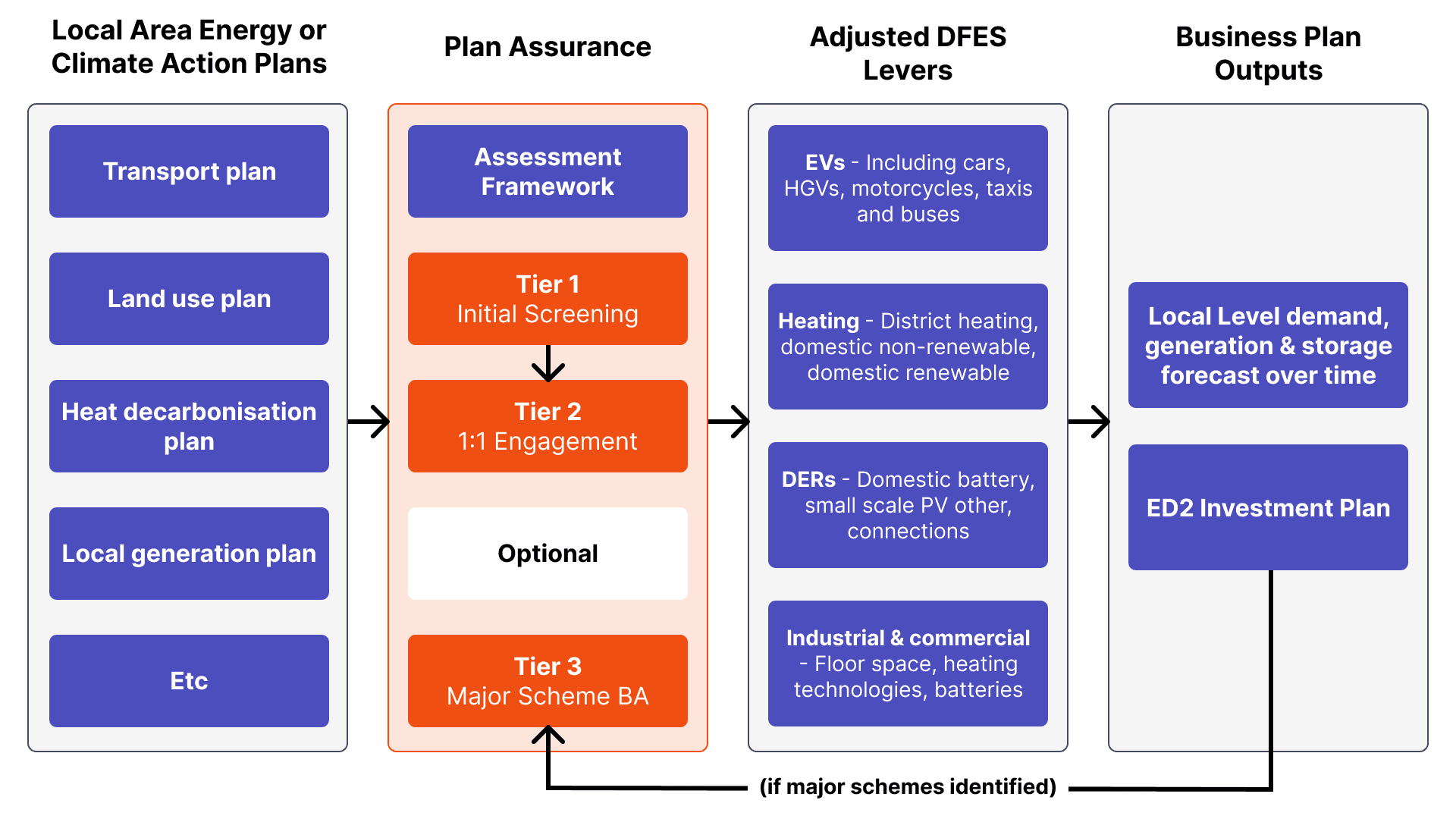
Assessment tiers and their impact on DFES adjustments
Tier 1
Tier 1 consists of undertaking an annual desktop review of all 133 local authorities’ energy/decarbonisation plans published on their .gov.uk websites.
The purpose of this annual assessment is to:
- Understand where local authorities are on their decarbonisation journey
- Ensure we provide the right support and resources to our local authorities
- Engage proactively with our local authority customers.
Local authorities’ plans are reviewed against six key themes in Tier 1: Ambition, Scope, Analysis, Stakeholder Support, Governance and Funding.
The findings from the Tier 1 assessment are summarised in the form of a data atory, titled ‘Your Decarbonisation Story’, which is available via the LAEP+ Planning Tool.
This data story is shared with the local authority officers and followed up with further engagement in the form of webinars, regional engagement sessions and 1-2-1 meetings where possible.
Tier 2
Tier 2 consists of two assessments, Materiality and Confidence.
Materiality Assessment
When a local authority has forecasts of low carbon technology uptake, and agrees to share these forecasts with us, an offline review of the forecasts provided is undertaken. Through this process, the difference in electrical demand between a local authority’s energy plans and our DFES Holistic Transition scenario are evaluated.
The purpose of this assessment is to identify potential areas of network constraints which the DFES Holistic Transition scenario may not have identified.
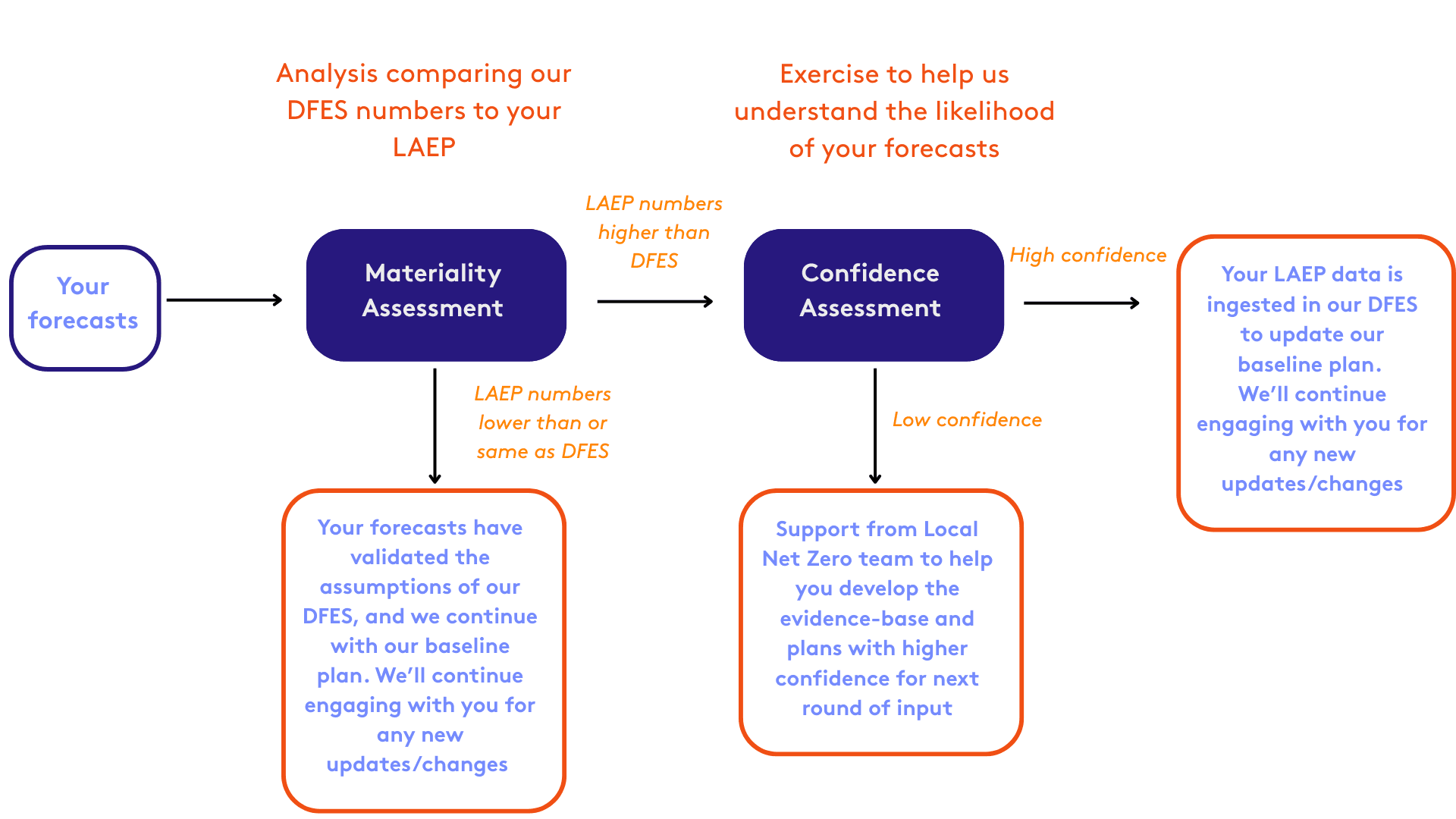
If the local authority forecasts are similar or lower than our DFES Holistic Transition scenario, our DFES assumptions are validated and we can continue with our baseline network plans.
To share data with us visit our Six simple ways to share page to find whichever way works best for you.
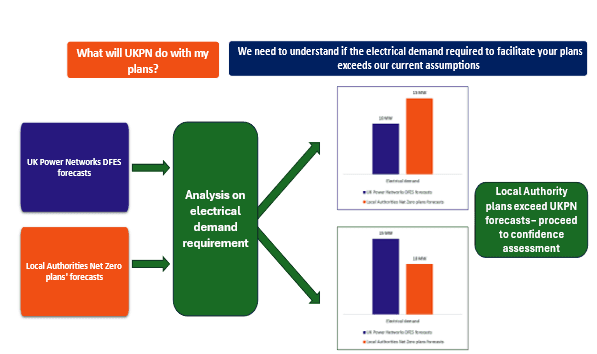
Materiality assessment example
Confidence Assessment
When local authority forecasts exceed DFES Holistic Transition
Under the LAEP Support Framework, we carry out a confidence assessment whenever the local authority forecast is higher than our DFES Holistic Transition scenario, the scenario we use to plan our network investment. The goal of the Confidence Assessment is to understand how likely these local forecasts are to materialise.
How the Confidence Assessment within the LAEP Support Framework works
Local authority plans are reviewed through the Confidence Assessment within our LAEP Support Framework across three themes, and by sector (transport, heat, and power). The three themes are:
- Quality of Analysis - How robust and evidence-based is the data and methodology?
- Governance - Are there clear decision-making structures and evidence of local authority cabinet approval?
- Deliverability - Are the plans practical and supported by resources and timelines?
Why the Confidence Assessment and these themes?
The Confidence Assessment, themes and assessment criteria were co-developed with local authorities to ensure they:
- Align to local authority processes;
- Are measurable and specific; and
- Drive a shared understanding of the credibility of plans
This joint approach helps determine together along with their appointed LAEP Practitioners whether adjustments should be made to UK Power Networks DFES forecasts.
How does it work?
Engagement and collaboration is key. The DSO Local Net Zero team collaborate closely and engage with local authorities and their LAEP Practitioners through the LAEP Support Framework to gather supporting evidence and documentation for the completion of the Confidence Assessment together.
To learn more about the Confidence Assessment, from details on the assessment questions per theme, and what is expected from different stakeholders, please read the overview guide below.
What the outcome of the Confidence Assessment means for DFES forecasts
Forecasts that are assessed to be of High or Medium confidence are included in UK Power Networks’ DFES, replacing existing assumptions. This is done to enhance UK Power Networks’ forecasts using LAEP data and to shape network capacity planning in response to local needs.
Tier 3
- Major Scheme or Project requiring engagement with National Grid transmission operator
- Local authority forecast indicates grid supply point interface activities
- Project flagged as strategic in the Confidence Assessment Deliverability section.
Book a meeting
Book a meeting with a member of the team – simply select a 30-minute slot at your convenience