Understanding the energy system

This section outlines at a high level the UK energy system and the key organisations involved, for more detail on this you can read our Energy Toolkit (pdf report), which we developed with UK100.
Contents of this page
What our team does and where we sit in UK Power Networks
UK Power Networks are the electricity distributor for London, the South East, and East of England. Within UK Power Networks there is the Distribution Network Operator (DNO) and the Distribution System Operator (DSO). Broadly speaking, the DNO is responsible for connecting new technologies, and maintaining the network, while the DSO looks to ensure that there is enough capacity on the network and looks to accelerate connections.
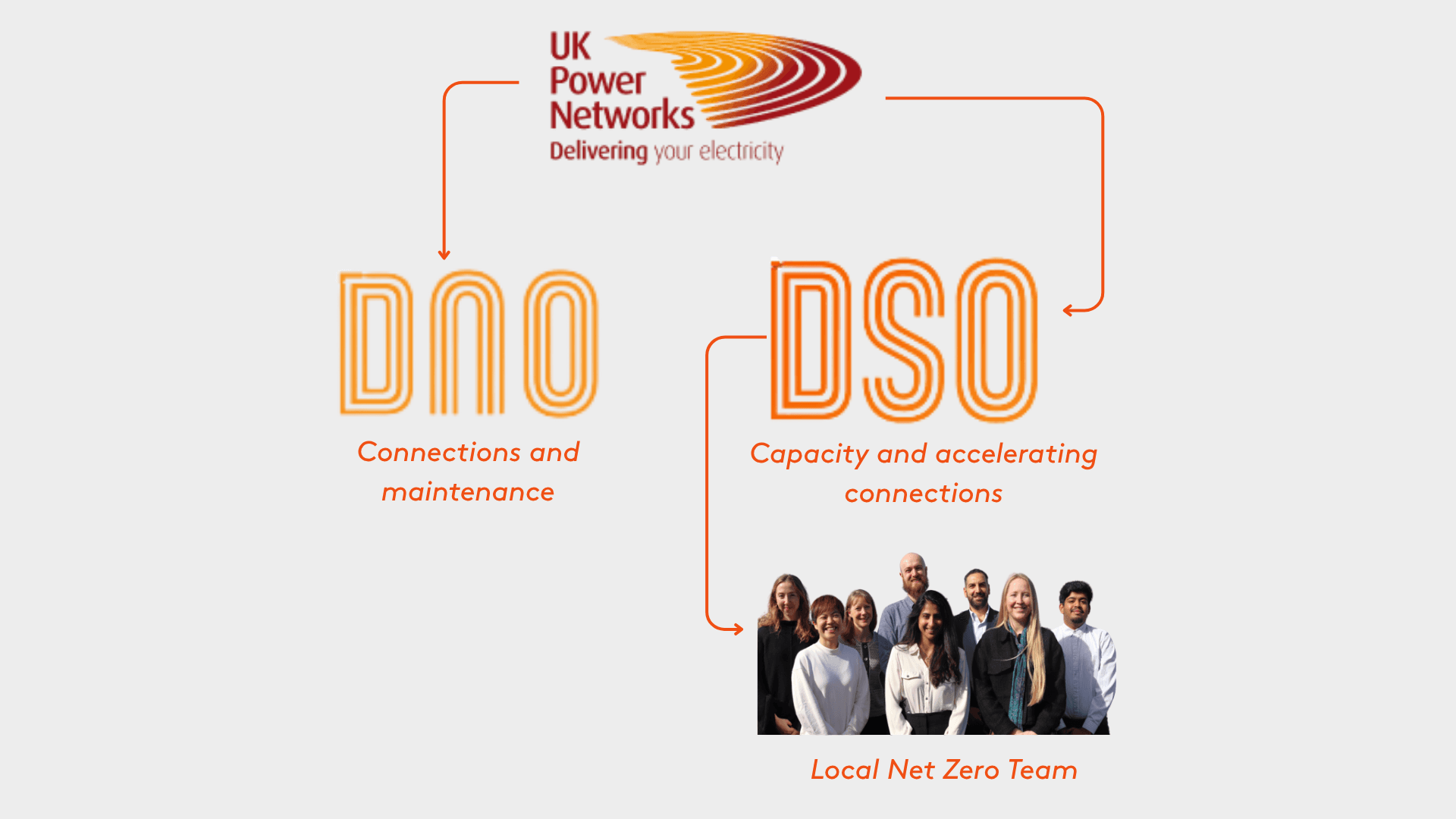
We are the Local Net Zero team, sitting within the DSO. Our role is to proactively engage with local authorities and their partners, and support them with data, digital tools, and enhanced access to the business. We also work with our customers to ensure that local targets for things like the uptake of electric vehicles and electrified heating technologies are reflected in our network development plans. Thus, ensuring there is capacity on the network to connect all the technologies required.
The Energy System
Generation
The system is transitioning from fossil fuels to renewable energy sources such as wind and solar. Renewable generation is distributed and variable, requiring a more flexible and decentralised system.
Electricity generators can either connect to the Transmission network or the Distribution Network, depending on their size. For example, a nuclear power plant would typically connect to the transmission network, whereas a 20MW solar farm would typically connect to the distribution network.
Transmission Network
High-voltage electricity is transported across long distances via the National Grid transmission network. This centralised infrastructure ensures bulk power delivery from generators to distribution networks.
Distribution Network
DNOs like UK Power Networks manage the lower-voltage networks that deliver electricity locally.
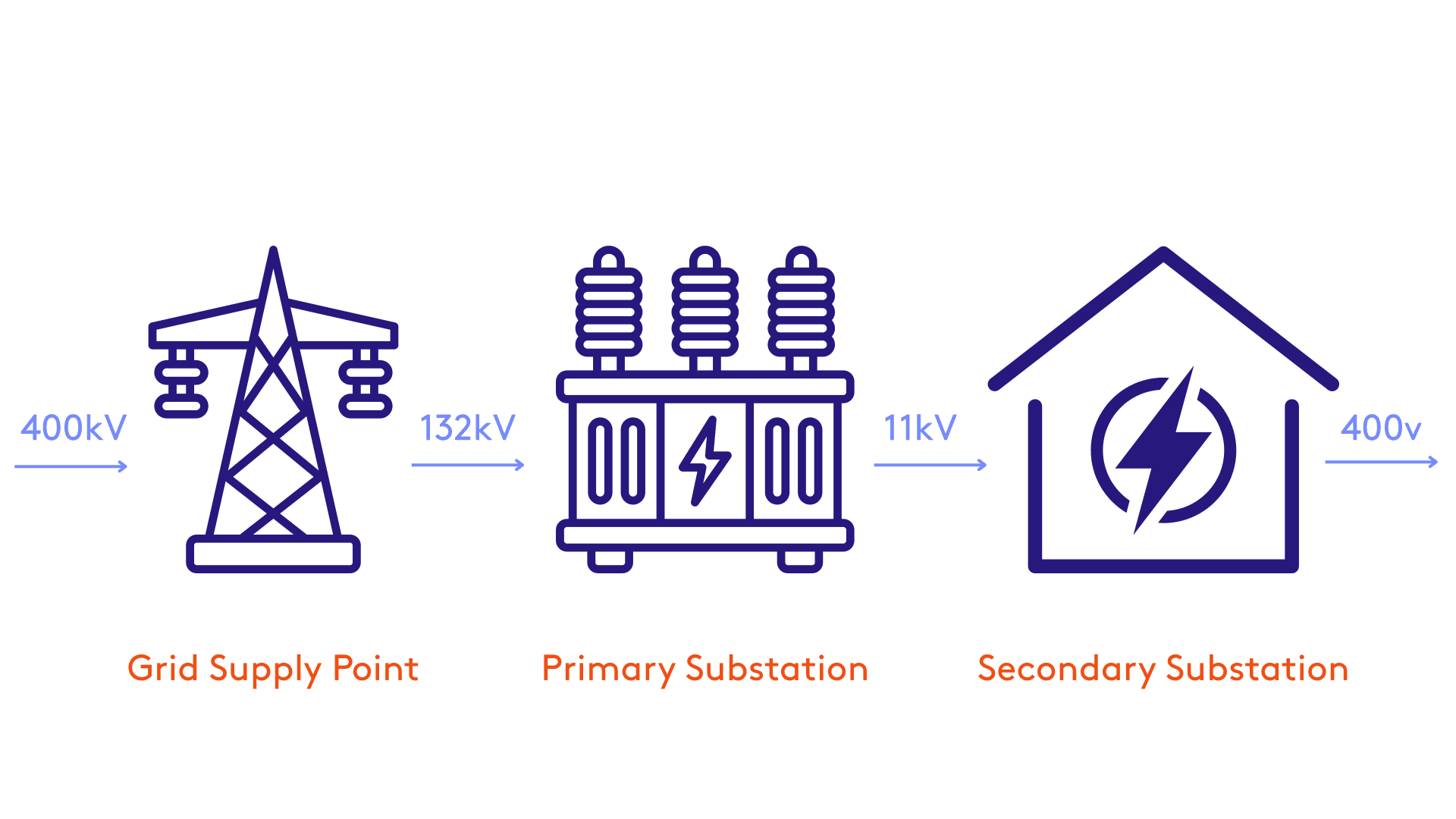
Typically, DNOs will receive electricity (at around 275kV or 400kV) from the transmission network at grid supply points, the voltage is then stepped down to either 132kV. Downstream of grid supply points are primary substations, where the voltage of electricity is stepped down from 132kV to 33kV or 11kV. Finally, the electricity reaches a secondary substation where the voltage is stepped down again from 11kV to around 400 volts, making it safe and usable for homes and businesses.
Suppliers
Energy suppliers purchase electricity from generators and sell it to consumers. They handle billing, tariffs, and customer service, and are increasingly offering green energy options and smart solutions.
Homes and Businesses
Consumers are becoming prosumers, generating their own energy (e.g. via solar panels) and feeding surplus back into the grid. Technologies like heat pumps, smart meters, and battery storage are enabling more efficient and responsive energy use. This evolving system supports the UK’s goals for energy security, affordability, climate action, and economic growth.
How LAEP Practitioners and local authorities fit in
Traditionally, we have added capacity to our network through developing forecasts of our expected increase in electrical demand and deciding what action to take on substations which we expect to become overloaded. Our Network planning page goes into this in more detail.
We know that the UKs transition to Net Zero is going to be influenced by local authorities, often supported by LAEP practitioners, through the development of LAEPs and other decarbonisation plans. LAEPs set the decarbonisation pathway and sets out implementation plans to achieve net zero for a local area.
We work with local authorities and LAEP practitioners to ensure that the decarbonisation pathway set out in each local authorities plans are reflected in our network development plans. This is done through our LAEP support framework.